
Image

Talk of the Trails Spring 2024

Tag: enviromental impact

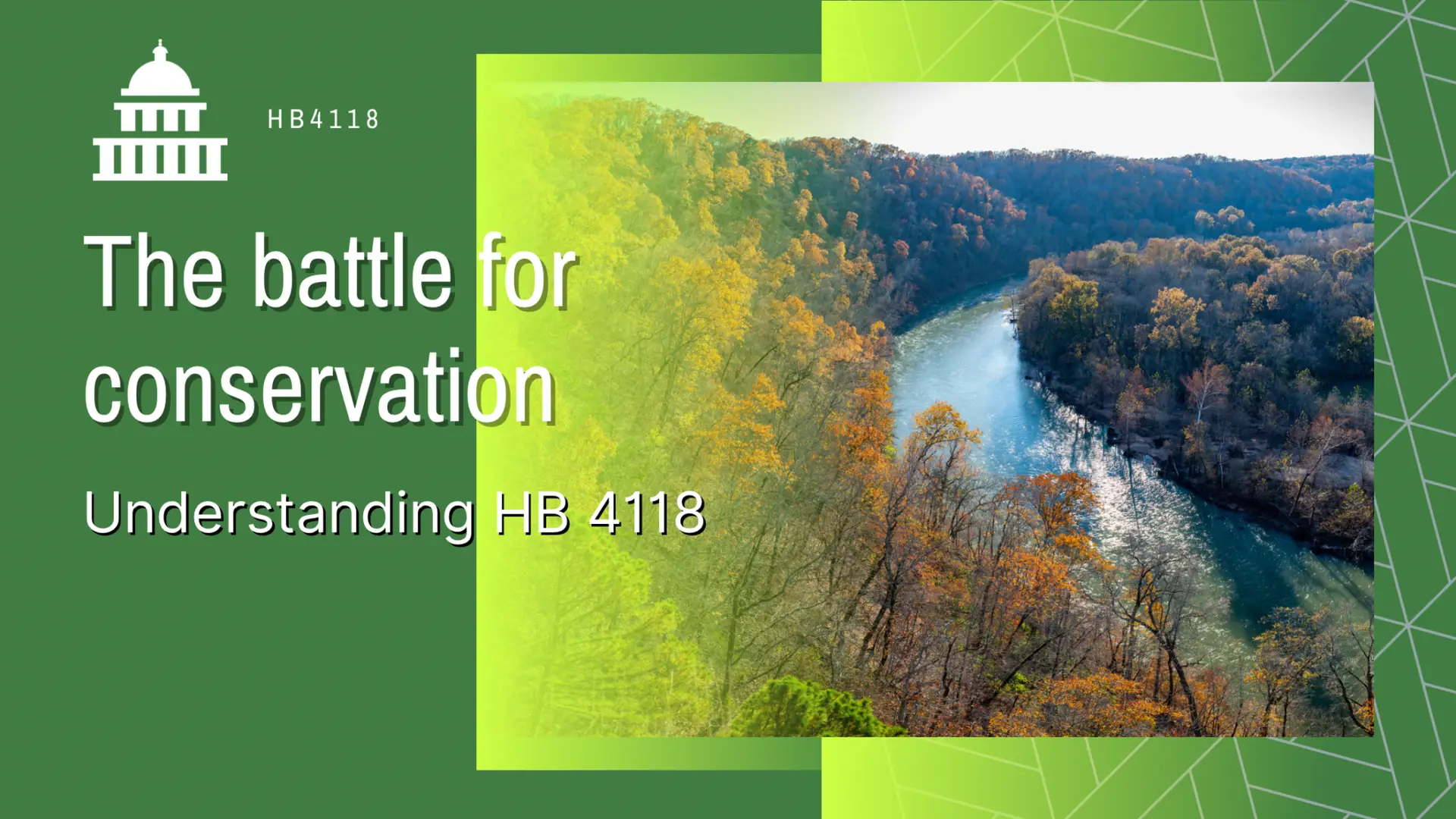
The battle for conservation: Understanding HB4118

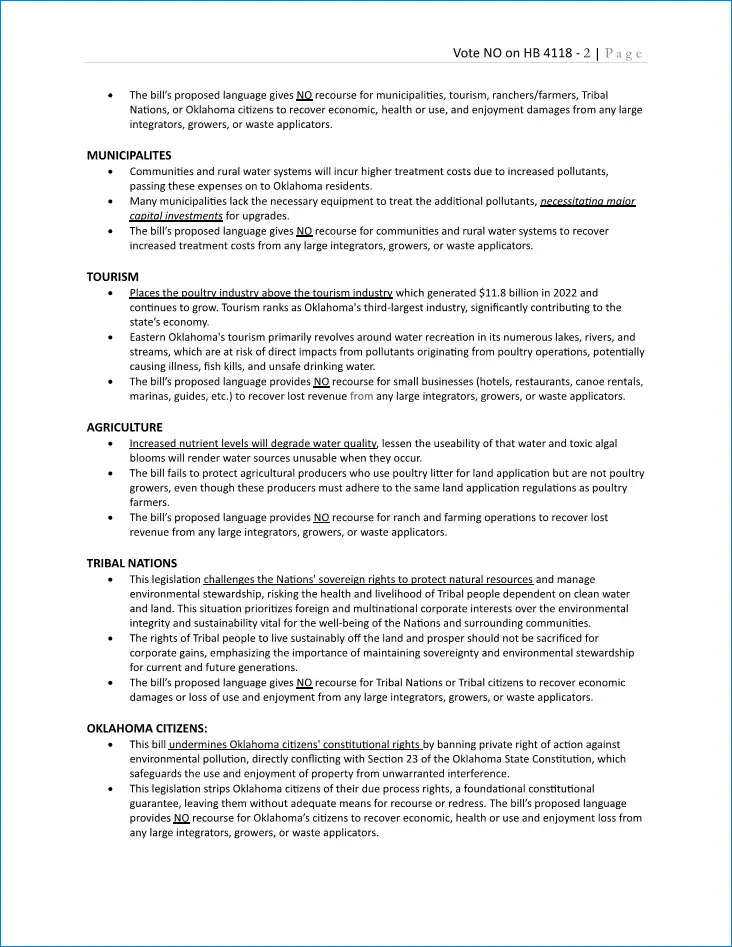
While we typically refrain from commenting on legislation, there’s a bill on the table that demands our attention. If passed, it could irreparably harm our cherished recreational wild spaces. Please take a moment to read the attached letter detailing our concerns and consider adding your voice to the cause.

– TUWC

The Conservation Coalition of Oklahoma (CCO) is currently embroiled in a pivotal fight over House Bill 4118 (HB4118), known as the Right to Farm bill.

This legislation, if passed, could have far-reaching implications for the state’s natural resources and wildlife. Here’s a breakdown of what’s at stake and how various stakeholders are responding:

What is HB4118?

HB4118 aims to grant extensive rights to poultry farms, particularly in regard to waste disposal. Proponents argue that the bill will protect the poultry industry, a major economic driver in Oklahoma. However, opponents fear that the bill will lead to environmental degradation, especially concerning water quality.Opposition from CCO and Allies CCO, alongside municipalities and tourism organizations, is leading the charge against HB4118. They argue that the bill does not comply with EPA requirements and could harm Oklahoma’s natural assets. Tribal nations, including the Choctaw and Chickasaw Nations, have also voiced opposition, highlighting the potential environmental and cultural impact of the bill.

Legislative Maneuvering

Despite significant opposition, HB4118 has garnered support from influential groups like the Farm Bureau and the Oklahoma Cattlemen’s Association. This has created a challenging political landscape, with urban and rural senators divided on the issue.Current Status and Future ProspectsAs of the latest update, the committee meeting for HB4118 has been delayed until April 1st. While there is optimism that there are enough votes to defeat the bill, unforeseen circumstances, such as the inability of a key legislator to attend a vote, could impact the outcome.

Looking Ahead

The battle over HB4118 is emblematic of the broader struggle between economic interests and environmental conservation. It underscores the importance of public engagement and advocacy in shaping legislation that affects our natural resources. Stay tuned for further updates on this critical issue.

Impact on Northeast Oklahoma’s Outdoor Recreation

Northeast Oklahoma has emerged as a popular destination for outdoor enthusiasts, offering a wide range of recreational activities such as kayaking, fishing, rafting, trail running, and mountain biking. The region’s natural beauty and diverse landscapes have attracted visitors from across the state and beyond.

However, the passage of House Bill 4118 (HB4118) could pose a significant threat to these tourism destinations.

The bill’s provisions regarding poultry waste disposal could lead to environmental contamination, impacting the waterways and natural habitats that make Northeast Oklahoma a prime outdoor recreation area.Environmental ConcernsChicken waste, if not properly managed, can introduce harmful pollutants into the environment, including nitrogen and phosphorus. These pollutants can degrade water quality, harm aquatic life, and disrupt the delicate ecosystems that support the region’s biodiversity.

Economic Implications

The adverse effects of HB4118 on Northeast Oklahoma’s outdoor recreation areas could have serious economic consequences. Tourism is a major driver of the region’s economy, supporting local businesses and creating jobs. Any degradation of the area’s natural assets could deter visitors and undermine the tourism industry’s growth.

Community Response

In response to the potential threat posed by HB4118, local communities and advocacy groups have mobilized to oppose the bill. They argue that protecting the region’s natural resources is essential for maintaining Northeast Oklahoma’s appeal as a recreational destination.

Call to Action

As the debate over HB4118 continues, it is crucial for stakeholders to voice their concerns and advocate for sustainable environmental policies. Preserving Northeast Oklahoma’s natural beauty and outdoor recreation opportunities requires a concerted effort to protect the region’s environment for future generations.

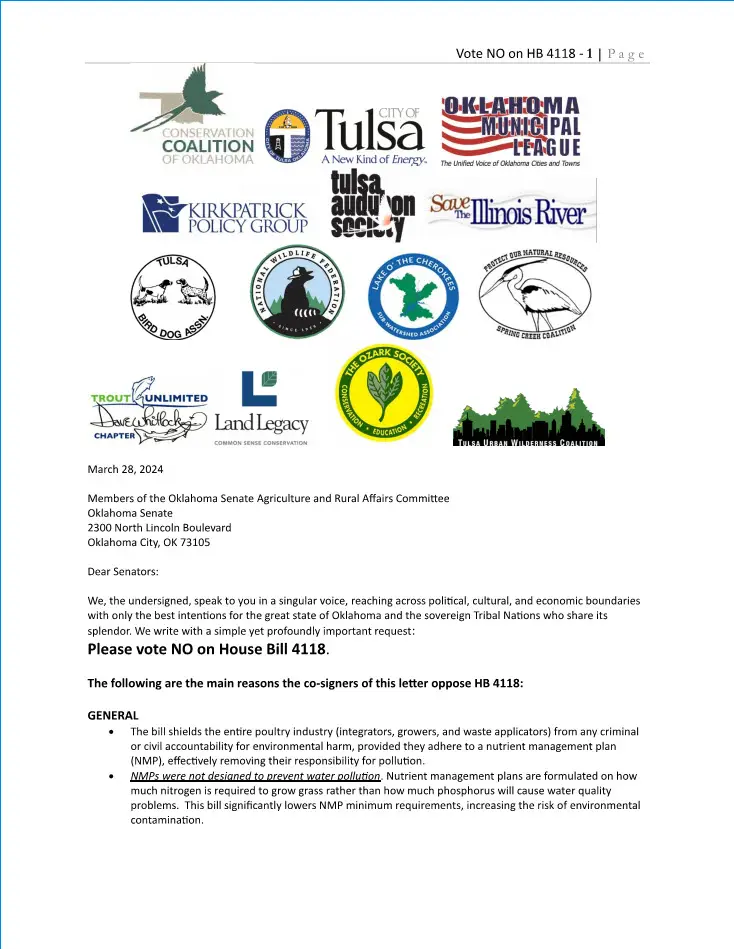
Letter from CCO Members
Read More

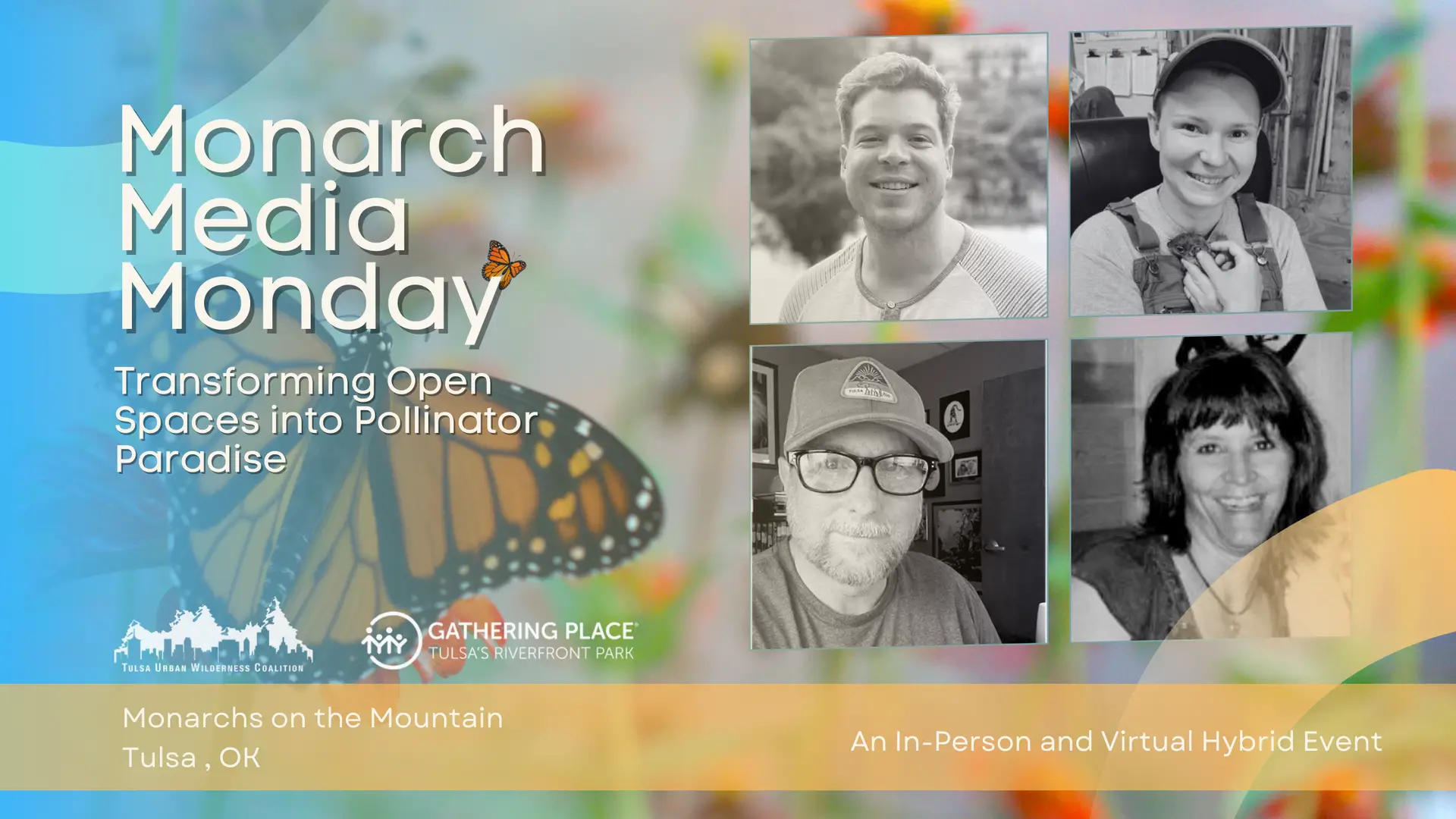
Monarch Media Monday 2023

Join us for a virtual interview on Monday, September 25th at 7PM as we celebrate the 8th annual Monarchs on the Mountain event hosted by the Tulsa Urban Wilderness Coalition. We’re thrilled to have Sara Dykman, the author of “Bicycling with Butterflies,” and the founder of Beyond a Book, as our guest. Don’t miss this exciting opportunity to engage with Sara Dykman and learn more about her journey and experiences.

The Trip:

In 2017 Sara Dykman became the first person to follow – by bicycle – the eastern population of monarch butterflies on their roundtrip, multinational, multigenerational migration. From Mexico to Canada and back, her 10,201 mile adventure,on a beat-up bicycle , was a call to action. “The monarchs need us,” Dykman explained, “they can’t call politicians to demand healthy prairies or rally for native gardens. But we can. We might not be able to fly like butterflies, but we can bike alongside them, and be their voice.”

Why monarchs?

As a whole, the migration advances at a pace a cyclist can cover. They also spread out in the millions across a landscape traced with roads, so there were few route-planning limitations. At home in backyards, school gardens, parks, roadside ditches, and the wildest places, monarchs are democratic in their reach. They are also beautiful and easy to spot, making them excellent gateway bugs and ambassadors of nature. Robustly studied yet still the subject of many unanswered questions, they are a testament to science. Threatened with extinction, the monarchs remind us what is at stake, and how important it is for each of us to do our part.

“You don’t have to quit your job and bike thousands of miles to help the monarchs,” explained Dykman. “You can plant milkweed, plant native nectar plants, and be a voice for the monarch. That’s what my trip, and my book, are all about.”

The Book:

Deftly combining travel memoir and popular science, Bicycling with Butterflies (Timber Press, April 2021) recounts Dykman’s inspirational ride alongside the monarchs. The cast of characters includes eager schoolchildren, devoted citizen scientists, skeptical bar patrons, fellow bicyclists. climate deniers, unimpressed border officials, and -of course- millions of monarchs. Dykman passionately shares the urgent plight of the monarchs and the complex science underpinning their dwindling numbers. Filled with optimism, energy, and hope, Bicycling with Butterflies is a compelling story, confirming the urgency of saving the threatened monarch migration—and the other threatened systems of nature that affect the survival of us all. “It is part science, part adventure, part love letter to nature,” Dykman explained. “I hope readers will come away with a deeper sense of connection to the land and be inspired to join the team taking care of our planet.”

“On this improbably adventure, Sara Dykman followed the extraordinary monarch migration by bicycle, and came back to write about it. She has recorded it well. Her almost incredible account captures the animal itself, the continent it crosses, and its plight with style and deep connection.” —Robert Michael Pyle, author of Chasing Monarchs and founder of the Xerces Society for Invertebrate Conservation

“People have long been fascinated by the monarch butterfly’s migration across the North American continent. Thanks to this book, readers have a better idea of what that incredible journey entails… Dykman’s enthusiasm will motivate others to be more thoughtful about their decisions.” —Library Journal

“The book is just as much a poetic travelogue as it is informative about monarch butterflies. Dykman’s research keenly supplements her experiences on the road…it may be one singular bicyclist’s word, but represents a collective cry for climate action.”—Booklist

Sara’s Bio:

Sara Dykman is the founder of beyondabook.org, which fosters lifelong learners, boundary pushers, explorers, and stewards. She works in amphibian research and as an outdoor educator, guiding young people into nature so they can delight in its complicated brilliance. She hopes her own adventures—walking from Mexico to Canada, canoeing the Missouri River from source to sea, and cycling over 80,000 miles across North and South America (including the monarch migration trip)—will empower young and old to dream big.

Read More

Notes From the TUWC Veep

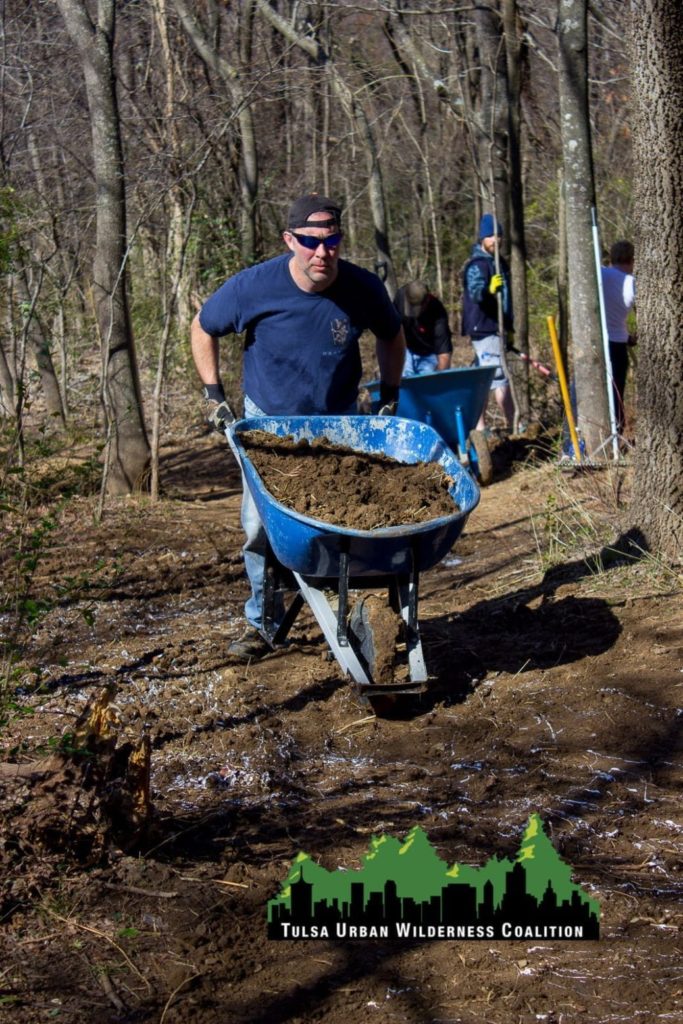
Trail work report: It’s unlikely that we’ve seen this level of work being done at Turkey Mountain, maybe ever. That, and with the new trails systems that have opened up at Lubell Park and Bales Park, the River Parks Authority and the city of Tulsa have been busy creating and enhancing trail systems that serve the region’s outdoor community. By now, you’ve probably seen some of the new multi-use and bike-only downhill trails at Turkey Mountain. Now, you’ll see something else: a stone staircase leading from one of the mountain’s lower trails that will ascend all the way to the top, linking up to existing trails that will give users the opportunity to ascend Turkey Mountain and gain access to some its more popular overlooks.

I’ve walked it with RPA’s Ryan Howell, and I can tell you this: It’s a work of art. It’s newly finished, and will be a popular go-to place for people to climb to the top of Turkey Mountain and will feature its own photogenic scenes. All of the rock used in the staircase was sourced from Turkey Mountain itself, and erosion-prone uphill trails that had become nightmare washouts will be left to remediate naturally. What’s more: The staircase is just part of what’s going on there now, and there will be work to create a variety of different trails – from multi-use, beginner-friendly routes to wilder paths that will challenge runners and cyclists. RPA, through various private, local, state and federal sources, has procured millions of dollars to turn its master plan into reality, and do it in a way that’s sustainable and erosion resistant.

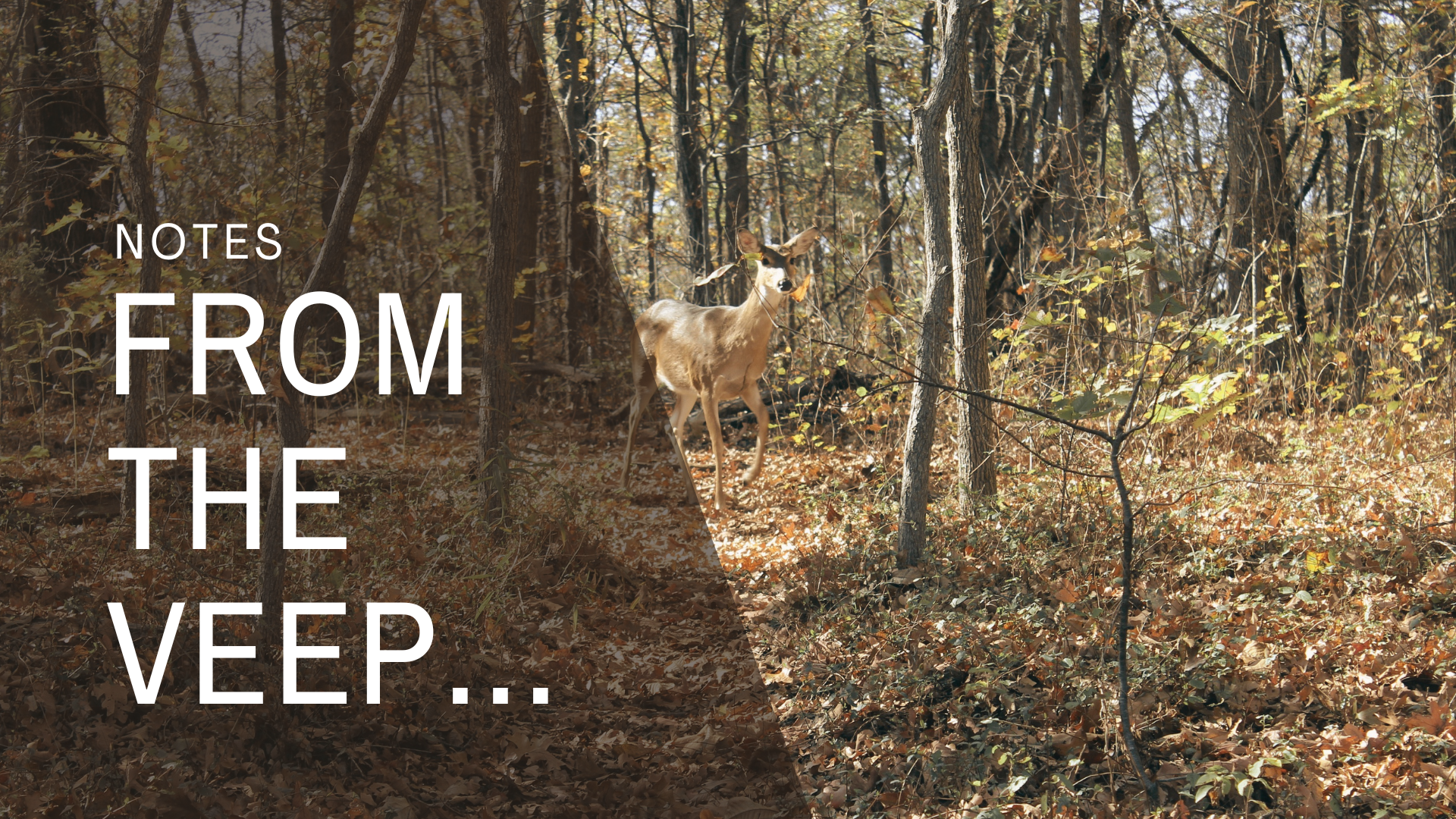
Update on the deer: A few weeks back, we all learned that someone poached a deer at Turkey Mountain. As of this writing, we are still unsure who illegally harvested the deer. It is very difficult to find and prosecute poachers unless they are caught in the act of shooting wildlife. That said, this reminder needs to be said: It is illegal to shoot firearms within the city limits, and hunting isn’t allowed at Turkey Mountain. The park is designed to be an urban wilderness, which means that part of its mission is to provide good habitats for plants and animals that live there.

So if you or anyone you know is tempted to hunt at Turkey Mountain, don’t. There are plenty of places in Oklahoma to hunt, and discharging a firearm at a place known to have a high level of human traffic is dangerous to other Turkey Mountain users. If you see someone hunting at Turkey Mountain, call Tulsa police.

Bob Doucette

Vice President / Govt Affairs

Read More

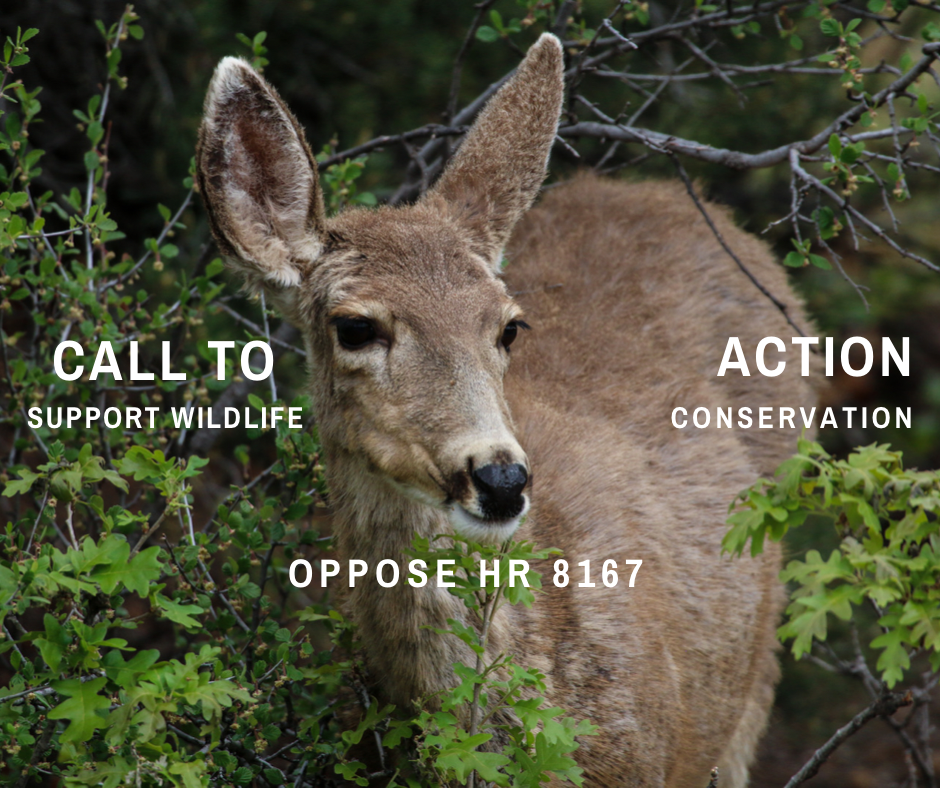
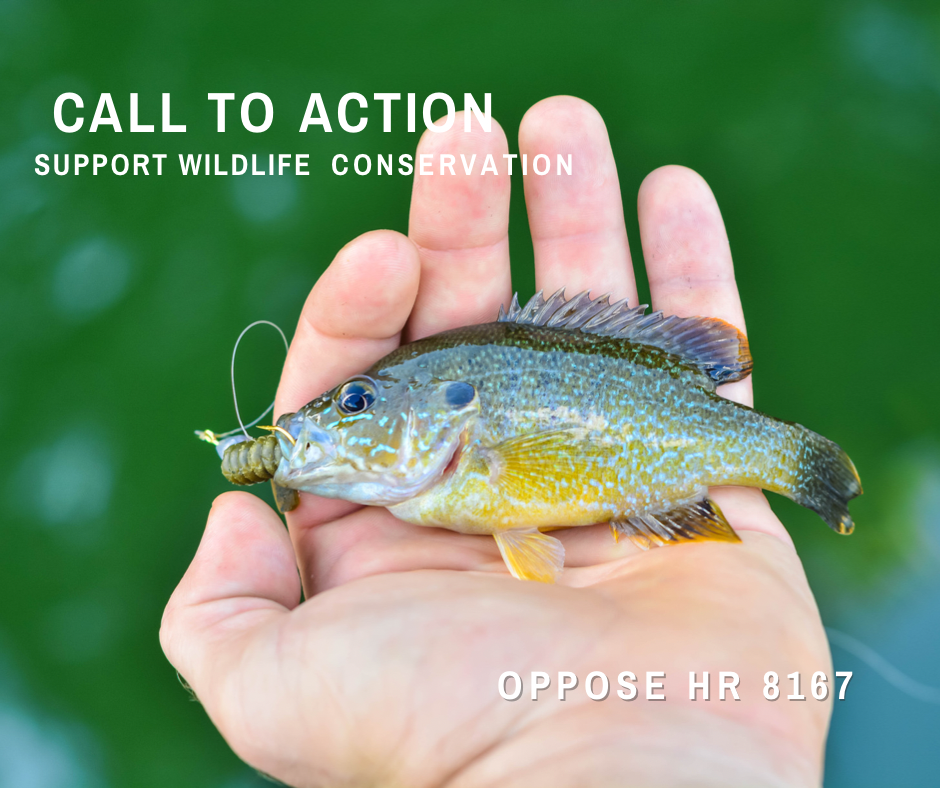
Call to action: Support wildlife conservation, oppose HR 8167 

Call to action: Support wildlife conservation, oppose HR 8167

Wildlife conservation is one of the longstanding aims for the Tulsa Urban Wilderness Coalition, so it seemed important to tell our membership about legislation moving through Congress that could have a dramatic impact on those efforts.

House Resolution 8167 would repeal the federal firearms excise tax and dramatically reduce the excise tax on fishing equipment. Laws that enacted these taxes were created at a time when hunters, anglers and conservationists became concerned about dwindling populations of wild game and other species.

Funds raised through these taxes go directly toward wildlife conservation. Since these programs were enacted, species such as deer, elk, wild turkey, various waterfowl and more saw dramatic comebacks.

In Oklahoma, the state’s Department of Wildlife Conservation receives a large portion of its budget from matching federal funds provided by the excise taxes in question.

HR 8167 would replace the excise taxes with revenue raised from federal offshore oil and gas leases. But those funds, by design, would only provide half the funds currently raised by the excise taxes.

HR 8167 is opposed by 43 hunting, conservation and gun rights groups, including the NRA.

What we see is a unified front consisting of hunters, shooting enthusiasts, anglers and conservationists who recognize what we see: The excise tax has been a win-win program for everyone and a longstanding conservation success story.

But HR 8167 has its supporters: 58 co-sponsors, including U.S. Rep. Markwayne Mullin.

What we would like to ask of TUWC members is to contact your congressional representatives and tell them to scrap HR 8167. If we lose wildlife conservation funds, we will lose wildlife at the places we like to go. Should HR 8167 become law, we will definitely lose funding. A loss of funding will harm wildlife populations and diminish species diversity.

Find out who your congressional representative is and let them know you oppose HR 8167. Write or call their offices in Washington, D.C., or at their local offices here in Oklahoma.

Tulsa-area congressmen are:

Kevin Hern: https://hern.house.gov/

Markwayne Mullin: https://mullin.house.gov/

Frank Lucas: https://lucas.house.gov/

For more, read this editorial from the Tulsa World: https://tulsaworld.com/opinion/editorials/editorial-firearm-tax-repeal-would-harm-conservation-hunters-interests/article_3d9c62b2-0d1a-11ed-b1c4-2b92166be689.html

Or read this writeup from the Conservation Coalition of Oklahoma: https://oklahomaconservation.org/wildlife-conservation-2/

Read More